
v5.0 / 2026-04-07
Players manage fleets of starships, and attempt to blast each other into protons. Ships are represented by counters on the map, and by corresponding ship sheets representing their states and capabilities.
The space map is represented by a 2D hexfield, a concession to tabletop gaming. On the map, each ship is represented by a Ship Counter, which is located inside a particular hex, and which must always face one of its adjacent hexes. Each ship also has a Vector Counter (though two are used for convenience during movement), also placed inside a nearby hex, which represents the location of the ship after movement if the ship executes no maneuvers.
The details of each ship are tracked on its Ship Sheet, which lists its Systems: hull, weapons, and various internal systems. Each of a ship's systems is listed as a collection of boxes, each representing one Damage Point (DP). Most systems also have a Rating, which represents its functional capacity; this is usually denoted by the left-most (undamaged) number inside the system's DP boxes. Some systems (like hull) have no rating, while others (like maneuvering jets) have multiple ratings depending on their state.
The components used for the game are as follows.
Each dice roll is a number of d10 (N) rolled against a hit number (H). All dice which roll ≤H are hits. Any die which rolls a "0" is counted as a hit, and rerolled for possible additional hits; any die which rolls a "9" is counted as -1 hits, and is rerolled for possible additional hits. All hits from all dice rolls total the roll's result. Normally, the effectiveness of a roll will be based on the result (the more hits, the more effective). Some rolls may simply require a mininum result in order to be successful, and a roll with hits less than this requirement will simply fail.
Rolls are noted in the rules as N@H.
Each ship's crew is divided into sections. Each section has a Skill between 3 and 6, totaling 15. Skill is the number of dice rolled for various ship actions, against a hit number determined by the health of the related system (as detailed in the next section).
When the last damage box in the hull section is damaged, the ship itself is destroyed and is out of the game.
A ship has six sides of plating, each which absorbs damage directed at the ship from attacks from its corresponding angle. Once all DP boxes from a plating facing is destroyed, then the plating is gone, and further hits go against the interior of the ship (as explained below).
A ship's reactor provides all the power a ship requires, but increased demand on the reactor is measured by Heat (tracked by yellow chips). Heat equal to the reactor's Coolant (indicated by the circled value on the ship sheet) is automatically removed during the Check Reactor phase of the turn; ships roll Engineering@Reactor to remove additional Heat. If the last damage box on the reactor is destroyed, the reactor fails, and the ship is out of the game.
Weapons are used to deal damage out to opponent ships and seekers. Most weapons may fire at most once per turn, and only at one target, which must be in the firing weapon's arc. A ship may fire at different target ships with different weapon systems, of course. Each weapon has a Hit Number, the value on each die rolled which indicates a hit. Weapons have one damage box each, and when destroyed, the weapon no longer functions. Weapons fire is explained below.
Fired at enemy ships. Beam weapons are rated by a list of ranges and H for the Gunnery roll used to fire it. The resulting hits are the number of damage points delivered to the target ships. 0 or fewer hits deliver no damage.
An example beam weapon is shown below.
| Class-D Neutral Particle Beam · 🗲 | ||||
|---|---|---|---|---|
| 4:8 | 9:6 | 16:4 | 26:3 | 37:2 |
When firing this weapon at a target up to 4 hexes away, it does a number of damage points equal to Gunnery@8. If the target were greater than 4 hexes away but still within 9 hexes, this would be Gunnery@6 damage points, and so on. Firing the weapon incurs 1 engine Heat.
Fired at enemy ships. Pulse weapons are rated by a list of ranges and the number of hits required on the Gunnery roll in order for the shot to reach the target ship, and by a set amount of damage that a shot will deliver.
An example pulse weapon is shown below.
| 3 · Class-F Plasma Cannon · 🗲🗲 · 10 | ||||||
|---|---|---|---|---|---|---|
| 2:1 | 6:2 | 10:3 | 16:4 | 22:5 | 30:6 | 38:7 |
Firing this weapon at a target up to 2 hexes away requires the firer roll Gunnery@3 and get at least 1 hit; at up to 6 hexes away, this roll must yield at least 2 hits, and so on. If this hit roll is successful, then the weapon delivers 10 damage points to the target. Firing the weapon incurs 2 engine Heat.
Fired at seekers. Interceptors are the only weapon which may affect multiple targets on a single use. They are rated in terms of range and hits required to destroy a seeker at that range. The firer rolls Gunnery@5, yielding a number of hits; these hits are then allocated to enemy seekers by the firer.
An example interceptor is shown below.
| 5 · Class-E Interceptor | ||||
|---|---|---|---|---|
| 5:1 | 11:2 | 18:3 | 26:4 | 35:5 |
For this weapon system, seekers within 5 hexes of the firer require 1 hit to destroy, seekers within 11 hexes require 2 hits to destroy, and so on. If the Gunnery@5 roll yielded 3 hits, then one hit each could be allocated to three seekers 4 hexes away; or, one to a seeker 3 hexes away and two hits to another seeker 9 hexes away; or, all three hits could be allocated to single seeker 15 hexes away. Antimatter torpedoes always cost twice the normal amount of hits to destroy as standard seekers. Interceptor weapons never incur reactor Heat.
Torpedoes are seekers launched by ships, which then become tracked on the map along with ships. Torpedoes are rated in terms of acceleration (how much a torpedo can change its vector each turn, in any direction) and warhead size. A torpedo's target is written down in secret by its firer, and tracks that target until destroyed, or until it strikes its target, doing its warhead in damage. This is more thoroughly described in the turn section below.
Antimatter torpedoes are seekers which work the same way as normal torpedoes, except that they must be charged (incurring reactor Heat) prior to being fired. One turn is spent charging the torpedo, and the following turn, it may be fired.
The Helm is the bridge and other components of the ship used to control it. Once the last DP of a ship's Helm is destroyed, the ship is adrift, and is removed from the map.
Targeting Computer rating is added to Gunnery skill, yielding more (at first) or fewer (later on) dice to weapons fire when attacking other ships.
Thruster rating represents the number of hexes by which a ship may alter its vector during the Movement phase, and how much reactor Heat each change incurs. When all boxes are destroyed, the rating listed to the right of the last box is used.
Maneuver ratings represent the number of facings by which a ship may alter its facing during the Movement phase, and how much reactor Heat each change incurs. When all boxes are destroyed, the rating listed to the right of the last box is used.
This is how many damage points the ship can ignore each turn.
Turns are resolved, in phase order, until the scenario resolution condition is met - usually when only one player's or one team's ships remain. The phases for each turn are listed below. Turns are played in parallel - all players perform Phase 1, then all players perform Phase 2, and so on. Once all phases have been processed, if more than one player or team is still active, play returns to the top of the phase list.
Initiative order for all ships is determined by all ships rolling Piloting@Helm, ties resolved by further rolls of Piloting@Helm. Ships move in inverse order of the results; ie, the player with the lowest Initiative moves first, then the second-lowest, and so on, with the ship with the highest Initiative moving last.
An example of movement is below.
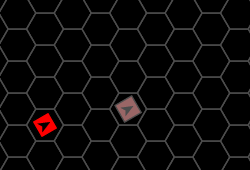 | 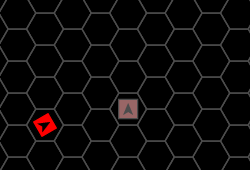 | 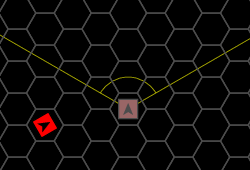 |
|||
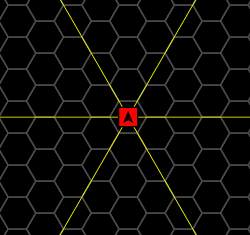
| Starting position: Ship (left) and vector (center) | Step 1: vector rotates 60°; incurs Maneuver Jets Heat | 120° front arc of new vector orientation | |||
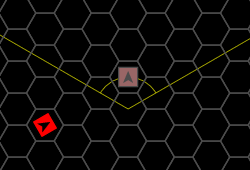 | 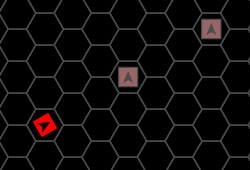 | 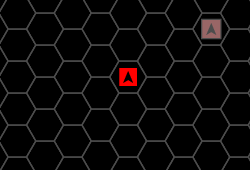 |
|||
| Step 2: ship moves 1 hex; incurs Thruster Heat | Step 3: new vector counter placed | Step 4: Updated positions of ship and vector | |||
Each of a ship's weapons may fire at any target the weapon's arc (as indicated on its ship sheet). Beam and Pulse weapons fire against other ships, and must specify that the shot will go against that target ship's Midships, Engines, Weapons, or Control. Interceptors are fired against seekers, and if a seeker is hit, it is simply destroyed.
The roll is (Gunnery + Targeting)@Weapon_H, where Gunnery is skill, Targeting is the current rating of the firing ship's Targeting Computer, and Weapon_H depends on weapon type as explained.
Each weapon's effectiveness is based on the Range in hexes to the target (either ship or seeker). For Beam weapons, the range determines the Hit Number (H) for the Gunnery roll; Pulse weapons have a constant H, and the range determines the number of successes the Gunnery roll must have in order for the shot to hit and deliver its damage; Interceptors also have a constant H, and a single Gunnery roll is made, and the range determines how many successes from that roll must be allocated to each target hit.
Successful damage against ships is recorded by chips, keyed by color to the target specification - gray for each Midships hit, red for Engine hits, blue for Weapons, and green for Control. These chips are placed on the target ship's sheet on top of the plating damage boxes corresponding to the direction of the incoming damage. This damage is resolved in the Resolve Damage phase.
Firing weapons usually incurs reactor Heat; this will be indicated on the weapons on the ship Sheets by lightning bolt symbols (🗲).
Each seeker moves following the same procedure for ships (in Phase 2) All seekers can change their facing by any amount per move, and by a number of hexes per move based on seeker type.
If a seeker ends its movement in the same hex as its listed target, it takes its effect on the target ship:
| Torpedo | The target ship suffers a number of damage points equal to the torpedo's warhead rating. These are always considered Midships hits, tracked with gray chips. |
|---|---|
| Breaching Pod | The target ship automatically loses 1DP of Helm. Shields do not protect. |
| Section | Roll | ||||||||||
|---|---|---|---|---|---|---|---|---|---|---|---|
 |
 |
 |
 |
 |
 |
 |
 |
 |
 |
||
| Midships | Gray | - | - | - | Hull | Hull | Crew | Reactor | Thrusters | Maneuvering | Shield Gen |
| Engines | Red | - | - | - | - | - | Hull | Hull | Reactor | Thrusters | Maneuvering |
| Weapons | Blue | - | - | - | - | - | Hull | Hull | Weapon | Weapon | Targeting |
| Control | Green | - | - | - | - | - | Hull | Crew | Helm | Targeting | Shield Gen |
Counters representing new seekers are added to the map. Each seeker launcher is noted on its ship sheet with a launch vector; the seeker is placed in the hex adjacent to the launching ship in the direction of its launch vector, and the seeker's vector is placed in the hex adjacent to the launching ship's vector in the same way.
For example, if a ship has a torpedo launcher with a launch vector straight ahead, then the torpedo will be placed on the map as follows.
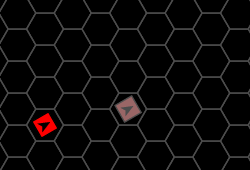 | 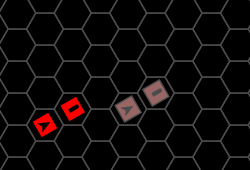 | |
| Position of launching ship | Position and vector of launched torpedo |
Firing ships record the seekers' targets in secret, and seekers must always seek this target during the Move Seekers phase. If a seeker's target no longer exists, it is removed from play.
Ships now remove a number of yellow chips representing reactor Heat equal to the reactor's Coolant (indicated inside the circle on the ship sheet) plus Engineering@Reactor. For each chip which remains, roll one die against the following table. After damage is rolled, yellow chips are not removed from ship sheets as is the case for combat damage.
| Section | Roll | ||||||||||
|---|---|---|---|---|---|---|---|---|---|---|---|
|
|
|
|
|
|
|
|
|
|
||
| Reactor | Yellow | - | - | - | - | - | - | - | Reactor | Reactor | Weapon |
All ships are now checked to see whether they remain viable. Ships with no hull left are destroyed, and are out; ships with no Helm are disabled and also out. In addition, any ship which has traveled off the map is considered "wandered off", and is also out. All remaining ships start a new turn.
Sessions are individual combat scenarios. Players are divided into teams (represented by colors), assigned ships, and then the scenario is run until its goal is met. Usually, this means that only one team's ships remain in play.