
v1.0 / 2026-04-27
Speedway is a game in which armed and armored cars drive around an arena and blast each other to bits, the last operable car being the victor. It owes much to the original SJG Car Wars, but the rules are very different.
The various components used in the game are listed here.
| Car Counters | These are rectangular cardboard representations of cars placed on the map. |
|---|---|
| Other Counters | These are counters placed on the map which represent other things, such as debris, mines, oil, water, smoke, paint, and other obstacles. |
| Dice | The game uses both normal and special dice differentiated by color. The normal dice are used to determine
success of weapons fire (ie, does a shot hit its target). Blue  , red , red
 , yellow , yellow  , green , green
 , and gray , and gray  special dice are
damage dice, as detailed in the Damage section, and white special dice are driver dice,
which are used for driving challenges as explained later. special dice are
damage dice, as detailed in the Damage section, and white special dice are driver dice,
which are used for driving challenges as explained later. |
| Status Chips | Inertia chips are collected by individual cars based on how crazily they drive. Fire chips are collected by cars as they catch on fire. |
| Speed Indicator | A counter placed on each car's sheet indicating its current speed. |
| Skid Indicator | If placed on a car counter, this will indicate the direction in which the car is skidding. |
Cars drive around the arena and shoot at one another. Each player controls one or more cars, and once a player's cars are all disabled, they are out.
At all times, each car has a speed, even if that speed is 0. This determines how many hexes the car will travel during its turn. Also, at all times, a car is either in control or out of control. Cars are in control normally, but circumstances may cause cars to be out of control.
On the map, a car is represented by a Counter, which always occupies two hexes (the front half of the car and the back half). It may have an additional skid indicator counter placed on top of it, if it is skidding.
Each car is also represented by a Car Sheet, which lists its capabilities and statuses, maintained by players off of the map. Capabilities are listed as a series of damage boxes, and the effectiveness of each (the rating) is indicated by the value in the leftmost undamaged box. If all boxes in a particular system is destroyed, then the value is indicated by the number to the right of all boxes; if there is no such number, then the system itself is disabled.
Each player's turn consists of a Upkeep phase, followed by the Movement phase.
The player performs the following actions for each car they control.
Each turn, a car will have a number of Moves equal to its speed. Each one of these moves will depend on whether the car is In Control or Out Of Control.
Car moves are selected from the following list. Each one has a cost in how many Inertia Tokens it earns its driver, and a Skid Speed, at which taking the maneuver may incur a skid. If a car takes a move at at leas the skid speed, the driver has a choice either to accept the skid, moving the car laterally along the indicated arrows, or to resist the skid.
Resisting the skid involves rolling a number of Driver dice equal to the car's Driving rating; if this value is equal to or greater than the car's speed plus its Inertia tokens, the driver retains control of the car and may proceed normally. If this roll fails, then the car moves along the indicated arrows, a skid indicator is placed on top of the car's counter indicating the direction of the skid, and it becomes Out Of Control.
At any point during its movement, the car may fire any of its weapons. No individual weapon may be fired more than once per turn.
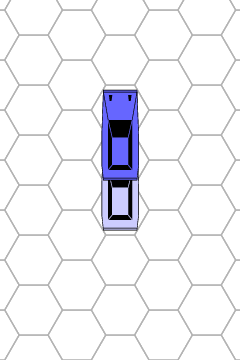 |
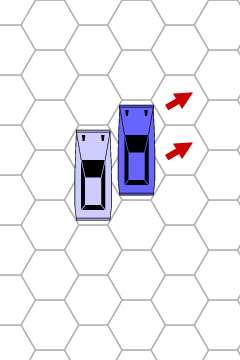 |
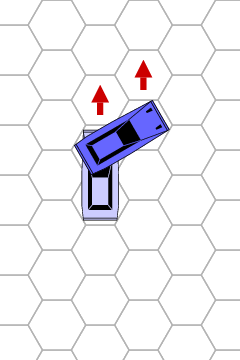 |
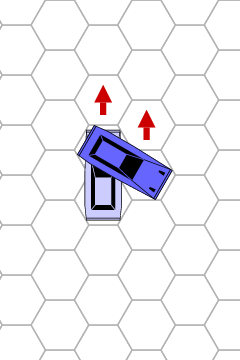 |
| Normal Move | Sideslip | Turn | Tight Turn |
|---|---|---|---|
| Skid Speed = 5; 1 Inertia Token | Skid Speed = 5; 2 Inertia Tokens | Skid Speed = 3; 3 Inertia Tokens |
When making a Sideslip, Turn, or Tight Turn, and any other car occupies either of the skid hexes,
the active player may expend an additional Move to Swipe that car. This does to
each car, and the swiped car gains an Inertia token. This action replaces the skid procedure above, so the driver neither
has to accept nor resist the skid.
If a car is Out Of Control, it moves one hex in the direction of its skid, then loses one point of speed, and then the driver may try again to regain control of the car as described above. The driver rolls a number of Driver dice to again try to roll a total of speed plus inertia tokens. If this roll is successful, the car once again becomes In Control.
If an Out Of Control car slides laterally into another car, it stops, and both cars take
.
If an Out Of Control car slides laterally into an immobile object, it stops by colliding with it, as described in the
section on Collisions. If the immobile object only contacts one of the car's front or back, but not both, then the car
takes , its speed is reduced by 1, and the car rotates its free side around the
obstacle.
Weapons are grouped into Offensive weapons, and Defensive weapons. Offensive weapons fire at other cars, while defensive weapons deploy counters to the map for cars to encounter later on.
Weapons are mounted on either the Front, Back, Left, or Right of the car, which determines the arc of targets which can be hit by the weapon. If any part of a car lies in a weapon's arc, it can be hit by that weapon.
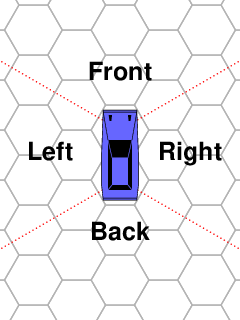 |
In order to hit an opponent car with an offensive weapon, the firing player rolls a number of standard dice equal to the weapon's undamaged boxes. This is usually 3, which means the firer would roll 3d6. The firer's Targeting rating is added to this, and if the total is equal to or greater than the range in hexes to the target car, the shot hits.
Each weapon has a list of damage dice that determine the damage it does, and at what ranges. These are listed on the weapons table below.
All offensive weapons must be able to trace a clear line of sight from one hex of their car to one hex of the target car, and the weapon has to be in the correct arc as shown above.
| Weapon | Damage Dice Per Range | ||||||||||||||||||||
|---|---|---|---|---|---|---|---|---|---|---|---|---|---|---|---|---|---|---|---|---|---|
| 1 | 2 | 3 | 4 | 5 | 6 | 7 | 8 | 9 | 10 | 11 | 12 | 13 | 14 | 15 | 16 | 17 | 18 | 19 | 20 | Max | |
| Recoilless Rifle |
|
|
|
Max = 15 | |||||||||||||||||
| .50-Cal Machine Gun |
|
|
Max = 20 | ||||||||||||||||||
| Vulcan Machine Gun |
|
|
|
Max = 15 | |||||||||||||||||
| 10mm Chaingun |
|
|
|
Max = 15 | |||||||||||||||||
| 40mm Grenade Launcher |
|
|
Max = 16 | ||||||||||||||||||
| Rocket Launcher |
|
|
Max = 12 | ||||||||||||||||||
| 20kW Laser |
|
|
Max = 20 | ||||||||||||||||||
| 30kW Laser |
|
|
|
Max = 20 | |||||||||||||||||
| Flamethrower |
|
|
|
Max = 9 | |||||||||||||||||
After damage is rolled, the target may disregard one result for each point of Armor the target car has. Damage results hitting the Armor itself cannot be disregarded. Remaining damage effects the indicated system, crossing off boxes from left to right. This will invariably chgange the corresponding rating, since there will then be a new leftmost value of that system.
| Roll | Result |
|---|---|
| A | Armor. Armor damage results cannot themselves be disregarded by a car's armor. |
| B | Brakes. |
| E | Engine. |
| F | An On Fire token is added to the car, but no immediate damage takes effect. |
| S | Suspension. |
| T | Targeting. |
| W | Weapon. Must be a weapon which could hit the firing car, if possible. The target player chooses if there are multiple options. |
| ⬤ | Any colored dot indicates a subsequent roll of another die. For example, a ⬤ indicates a roll of a Blue die. |
| Blank die faces have no damage effect. |
When fired, the corresponding hazard counter is deployed to the map. The firing car is immune from the hazard until it moves more than one hex away from it.
When fired, a mine counter is placed directly behind the car.
The first time any car enters a hex with a mine in it or a hex adjacent to a mine, they make a Driver roll against
a 3. If this roll fails, the mine explodes, doing
to all cars on or adjacent to the mine hex, after which the mine is removed from the map.
When fired, an oil counter is placed directly behind the car, and does the same for each of its next four moves.
For each oil hex a car travels through, it gains an Inertia token.
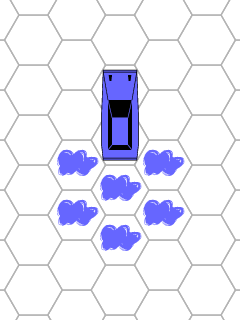
When fired, smoke counters are deployed to the hexes as shown. They remain on the map until the beginning of the driver's next turn. Cars cannot fire offensive weapons through smokesceens. If any car enters a smoke hex, the smoke counter is removed.
 |
A collision is either a car running into another car, or a car running into an immobile object.
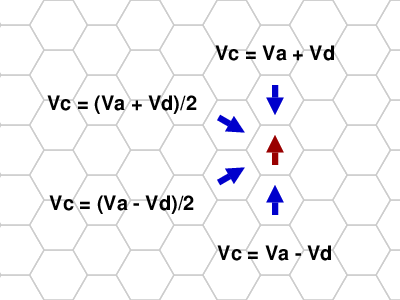
These are circumstances where the front of one car, called the Attacker, runs into at least one hex occupied another car, called the Defender. The Collision Speed (Vc) is based on the speed of the Attacker's Speed (Va), the Defender's Speed (Vd), and the angle of the collision, as shown in the diagram below. The attacker's directions are shown in blue, and the defender orientation is shown in red. Fractional Vc is rounded down.
 |
Stopped cars move no further in the current turn, and begin their next turn at Speed 0.
When a driver takes a Sideslip, Turn, or Tight Turn maneuver, and either of the skid hexes
contains any part of a car, the driver may choose to expend an additional Move to bump into that car. This does to both cars, the target car gains an Intertia token, and the Attacking car ignores the
skid procedure as described in the Movement Phase.
If a driver is Out Of Control and slides laterally into another car, the moving car stops, and both cars take
damage.
Drivers may strike immobile objects like walls, posts, and the like. If this is a straight-on collision, then
the moving car rolls a number of Gray dice equal to its speed, and then stops. If it slides laterally into an
immobile obstacle, but only one hex of the car is struck, then the car takes
damage, its speed is reduced by 1, and the car rotates the struck hex around the obstacle.