
v3.0 / 2026-07-30
Varmint Vacuum is a game in which players represent populations of vermin (represented by their particular color), moving through underground tunnels and warrens. The game board starts out as a small cluster of tiles, but expands as the game progresses. Players try to establish colonies in these warrens before too many of them get pulled away by the dreaded Varmint Vacuum.
| Varmints | These are individual Varmints belonging to each player, and are represented by colored wooden cubes. They are kept in each players' supply until deployed to the tiles making up the board, where they occupy chambers and move around the map. |
|---|---|
| Tiles | Tiles form the board, which grows from a simple seven-tile cluster, outwards as the game proceeds. Tiles are more fully described below. |
| Progress Track | This is the scoring track of the game. The first time a player places their scoring chip on the last entry on the Progress Track, the rest of the players play their last turns, and the game ends. |
| Colony Chips | These represent varmint colonies. Once placed on the map, they remain until the end of the game. One of each players' colony chips is placed on the Progress Track to be used as a scoring chip. |
| Indicator Tokens and Indicator Bag | These are round tokens which correspond to hex Vacuum Indicators, and the bag used to randomly select them. Some tokens are kept in the indicator bag, while some are temporarily kept in front of players bag awaiting addition to the bag. This will be explained in a later section. Other indicator tokens are kept in the supply, awaiting use. |
| Rumble Bag | This is the bag used to resolve Rumbles, as explained later. |
Tiles make up the board for the game. They are kept in a face-down draw pile, and added to the board as the game goes on.
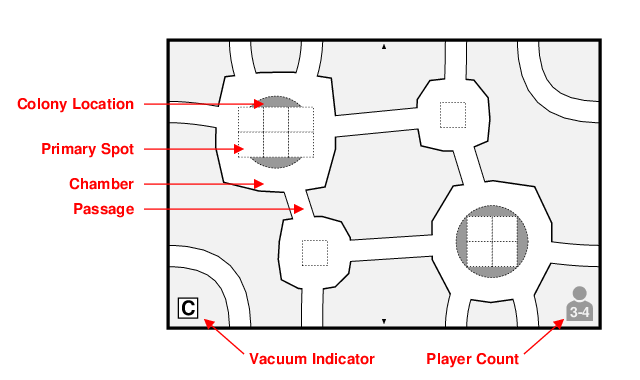
A Chamber is an area on a tile which may hold varmints. A chamber may hold any number of varmints, but only some of these varmints will occupy the chamber's Primary Spots. Some chambers also contain Colony Locations where colonies may be established. Once a player establishes a colony on such a location, they place one of their colony chips there, claiming the location, after which no other player may establish a colony in that location.
Passages connect chambers, and a moving varmint will follow a passage from its chamber to the chamber the passage leads to, regardless of passage length. Passages which lead off the current map cannot be traversed.
These potentially match Vacuum Indicator Tokens drawn from the Indicator Bag during Vacuum Events, as explained later on. The starting central tile has an indicator of A.
These indicate the player count for the tile. If the number of players isn't matched by the tile, it is discarded after being drawn, and replaced with a fresh tile.
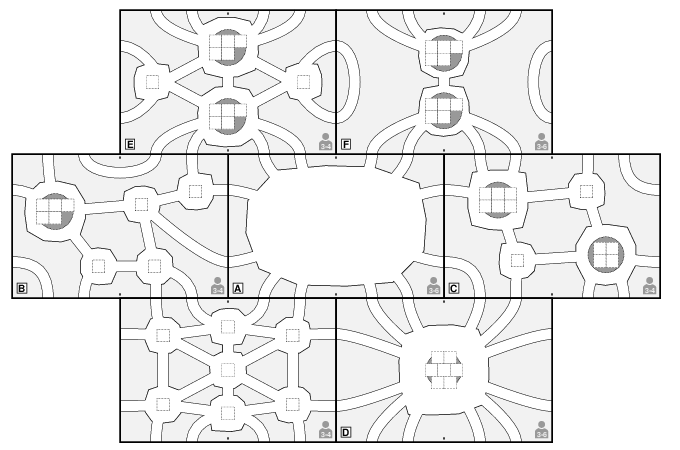
Each new tile must be placed adjacent to an existing tile, and must be placed horizontally (either right-side-up or up-side-down), vertically aligned with those on the left and right, and half-aligned to those above and below, in a brick-like pattern. This will always result in pairs of passage connections. Each tile has two small black triangle indicators to show the locations of the left or right edge of any tiles above or below them. An example is below.
Players take turns in player order, starting from the first player. Each player has a certain number of Action Points (AP) each turn, to be spent on the following actions. Once a player has expended their AP for their turn, turn passes to the next player. For the first turn of the game, the starting player has 3AP, the next player has 4AP, then 5AP, then 6AP, and afterwards, all players then have 7AP per turn for the rest of the game.
Once any player's scoring token reaches the last box on the Progress Track, then the game will end after the remaining players in turn order take their turns. This ensures that all players have the same overall number of turns in the game.
The first thing that a player does each turn is to add any Indicator Tokens in front of them to the Indicator Bag.
In the descriptions below, the Active player is the player whose turn it is, and Other players are everyone else.
| Move | 1AP | The active player moves one of their varmints along a passageway from one chamber to another. If there are unoccupied primary spots, the varmint goes into one; otherwise, it just goes into the chamber. Varmints may not be moved along passageways which lead off the map. |
|---|---|---|
| Settle | 0AP | The active player may move one of their varmints from its chamber into an unoccupied primary spot in the same chamber, if one is available. |
| Hunker | 1AP | The active player may swap the places of one of their varmints with a varmint of another player in a primary spot in the same chamber. |
| Reproduce | 2AP | The active player chooses a chamber. If the chamber contains a single varmint, they add one to it; if the chamber contains two or more varmints or is one of their established colonies, then they add two to it. |
| New Blood | 2AP | The active player places two varmints either on the chamber in the center hex, or in any chamber where they have a colony (not in the primary spots). |
| Push | 2AP | The active player chooses a chamber. If they have two or more varmints there, and another player has only one varmint present, the active player may move that other varmint along a passageway to an adjacent existing chamber (ie, not off the map). |
| Consolidate | 3AP | The active player chooses a chamber where they have more varmints than any other single player (ie, the active player has a plurality in the chamber). All other players (in player order) move one varmint to an adjacent chamber. |
| Rumble | 4AP | The active player chooses a chamber. All varmints in that chamber are removed and placed into the Rumble Bag. Then, a number of varmints equal to the number of primary spots in the chamber (or all varmints in the Bag, if there are fewer than this number), and these are placed into the chamber's primary spots. Next, an equal number of varmints are drawn from the bag, and these are returned to their respective players. Finally, any varmints remaining in the bag are placed in the chamber. |
| Vacuum | 4AP | The active player draws two vacuum indicator tokens from the Indicator Bag, and chooses one. If the chosen Indicator has a letter on it, then the Vacuum Event affects the corresponding tile. Blank Indicators may, at the option of the active player, indicate any tile referenced by an Indicator token in front of any player (ie, who has just established a colony - see below); otherwise, blank Indicator tokens have no effect. If a Vacuum Event takes place on a tile, then all varmints on that tile are removed and returned to their owners. Then, all varmints on all adjacent tiles not in primary spots are also removed and returned to ther owners. Colony chips are unaffected. |
| Draw New Tile | 4AP | The active player draws a new tile at random, and places it adjacent to the existing map, in accordance with the tile placement rules explained above. |
| Establish Colony | 5AP | The active player chooses a chamber in which they occupy all primary spots, but in which no colony is currently established. The active player removes all the varmints in the primary spots, and establishes a colony there, placing a colony token in that chamber. They then place the corresponding vacuum indicator token in front of them; this token will be placed into the indicator bag at the beginning of their next turn. They then move their scoring chip up on the progress track, and if this moves them into the last box, this triggers the end game condition. Every other player in turn order finishes out their turn for that round. |
Once a player has reached the last box of the Progress track, all remaining players in the turn order take their last turns, and the game ends. Whoever has the most colonies wins, and if there is a tie, then the player with the most varmints on the board wins. If there is still a tie, then the player with the most varmints belonging to any player in their colonies. If there is still a tie, the leaders share the victory.